My audio karma sees my convert to full-range speaker is sort of going back to fundamental of repro sound: the perfect phase and point source. You must audition to comprehend the quality of full-range speaker despite some full-range speakers show relative flat frequency response but not really the case in listening. The possibly worst-case scenario is nasal at mids and shouty at the lower treble range. At the risk of looking stupid, I will not at the top of my lungs neutrality or linearity. What does flat frequency response mean to you if it doesn't introduce aura, it's merely a meaningless soundwave. On the contrary, I seek emotions in sound, sound that draws you into music that keep you listening. I think it's not out of this world that, you're struggling with some fine systems, the sound somewhat doesn't tickle your senses, furthermore it sounds no wrong. A sad story, a disappointment nevertheless. Fidelity without musicality, devoids of the richness and depth of sound, perfectly measured, your brand of sound? How measurement read hollowness? I like to know. An engineer's perspective of sound, DSP sound correction is a joke to me, I'm sorry. Does anyone know piano tuning is done electronically? Probably Artificial Intelligence will one day.
In the meantime, loudness altogether is a different animal. Loudness gives rise to sensory stimulation, not necessary good sound. The sound of the rock concert is about loudness and dynamic, it's about attitude, it's about social grievances and discontentment. Rock music is an avenue to release displeasure. The crash of cymbals and the kick drum heighten the drama.
As we grow in age, our taste in music changes. We inclined to an intimate vocal and classical music as we grow old, so does our sonic perspectives, we even prefer the mild flavour. Sonic purity cream rises to the top. As opposed, a wannabe wanted super tweeter to launch the highs to the moon and subwoofer to power pile to the deepest abyss, all in the expense of phase coherency. He then crashes you with a heavy truck of sound pressure while he stands aside with a cheeky smile to see you tap out since no normal systems can play that loud. His peer give a round of applause.
Those days were far behind me now, I banked on my Belle's strength, the design strength of full-range speaker; phase coherency, immediacy and directness. These qualities are in the wheelhouse of full-range speaker. No constant crossing over to different driver membranes that sing to a different tune and smearing of the passive components on the crossover. And if these don't turn you on, there are no reasons for you to consider full-range speaker whatmore with a restricted frequency range for your disposal.
We are lucky to be able to enjoy live classical music for a little money albeit second class performers. How many musicians made it to the philharmonic orchestra? It takes about 80 musicians to give you a symphonic piece, to balance the book, no orchestras in the world could survive without the sponsorship! Anyway, you don't like classical means you don't like classical, enough said.
It has been quite a while now since my last classical concert, I'm really looking forward to my coming classical concert this month, my soul food. The sound, what can I say? So pure and right, some flashes of the electric-like audible buzz of the violins not even captured in the recording. My collection of classical, never one present me this. What say you?
Upgrading is like candy, highly irresistible even to the senior audiophiles. The better components and conductor brings about a new playing field though the circuit is more or less the same. Sure, they will improve sound quality. From 4K to 8K flat-screen TV is a natural progression, but the reverse is a struggle, so many things are missing. This is where your listening ability is gauged, knowingly or not knowingly. Without mercy, you will be labelled if your listening ability or your system falls short of expectation. In point of fact, upgrading is a big part of audioing, your main source of knowledge and experience. My take is the sound of any audio products carries a certain standard unless it is a matching issue. With equipment out of the way, your room could mess up the sound more than you ever know. Mind you, the sound opens up by simply rearranging the furniture and fixing, not something equipment upgrade could do. A pandora box, of course, a good sound requires more than moving your furniture and fixing.
One plus one is two, really? To excel in any passion, you must be crazy, being usual is out of the question.
Showing posts with label Speaker. Show all posts
Showing posts with label Speaker. Show all posts
Tuesday, October 1, 2019

Monday, April 29, 2019
A new chapter
As you may already know, my blog isn't about rave equipment reviews. Nope, it's my little cyberspace to talk audio here. There're plenty of reviews to read, or is it not? Old wine in a new bottle and with a twist of the story, mostly. High-end audio is a man's fantasy. Like sports cars, they attract eyeballs, a few can afford.
The state of tranquillity of mind is when you're at ease with your sound. Only sound and sound alone, the gold standard that stands the test of time. My views might be offbeat and unconventional, maybe even boring to some, it's perfectly OK if you don't concur with me. You don't need to, I can respect that. We all come from different audio backgrounds and if you don't like what you read, leave in peace.
Forever looking for ways and means to improve the sound, this is absolutely the audiophiliac thing, isn't it? Welcome to the sick club, you get a lifelong membership without the usual subscription fee. Non-audiophiles think audiophiles are nuts. To audiophiles, it's a whole lot of fun. How to get closer to the music? This thought runs in my mind, leaves me high and dry. I desire my sound to sounds close to music. It's not the tone. What is it?
A question we must ask ourselves, what sound do you want? Sonic effects or music? Hallelujah! My question is answered early this year in Taiwan, full range speaker. A spur to the road less travelled, fingers crossed. To my ears, full range speakers make music. For power and scale, bigger multi-driver speakers do better, moving more air and composed. Full range speakers carry a connotation of "less is more". Bass is not their strong suit. The speaker approach has always been high-efficiency against low efficiency.
Get the right speaker size for the room and save yourself troubles. Never pick a fight you can't win. Given a small room, full range speakers fit my bill perfectly. Small rooms choke bass, leaving little room for bass to stretch legs. Since most music falls in 55Hz to 5kHz region, in my opinion, it makes perfect sense to strive for a flawless 55Hz to 5kHz. I know it's conservative, a good midrange is the grand prize. I'm talking about immaculate coherency and homogeneity. What does a flat frequency response tell you? Nothing.
By assigning the task to only one driver, it kills three birds with one stone, a point source behaviour, eliminating the need for crossover and absolute phase coherency. No crossover, no phase shift, no time delay, no ambiguity. So, I was in a dilemma, realising a dream or enduring the financial stress. You all know what comes next, I gave in to sound.
For sure, a DIY project is not for the faint-hearted. I must admit the uneasy feeling of never know what you will get. Furthermore, no resale value and possibly a failed project adds insult to the injury. The problem with crossover, they are made out of capacitor, resistor and inductor, they eat details for breakfast and pukes sonic veil. Exotic components are not the perfect solution, I smell a rat. On the other side, full range speakers aren't without problems, they carry a peculiar sound, don't they always do? Far for neutral, the peakiness is glaring if you're coming from multi-driver speakers. That's a symptom when you overstressed your employees, they got grumpy. A field coil full range driver costs a bomb, besides, good sound from full range speakers come down box design, this is the tricky part. Speaker box design is the less understood subject. No bulletproof box design but empirical evidence. A weak bass is not good.
Aesthetically, I hate my speakers a sight for sore eyes, two tones veneer, a feature black wood at the front panel, hickory at the side, an expression of my taste. Given the job order confirmed near Chinese New Year, my speakers arrived at my door front at the end of March. I shall name my new speakers after the lovely veneer lady. Thanks, Belle.

Belle comprises of a pair of super tweeters and main towers. Ribbon super tweeter is my choice for their wide dispersion. Not dynamic super tweeters, the beaming, the pistonic character will attract attention. The point is, super tweeter is to aid space and ambience, nothing more. Due to ageing, there's a good chance that we couldn't hear things above 12kHz when we hit 50. Consequently, by moving the phase issue way up above my audible range, it will not be an issue.
The real battle begins when getting Belle to sing. Never take on a system set up lightly, it's not something you do every day. At the lower end of high efficiency at 93db/W/m sensitivity, I called YBA 1 Alpha for duty, a sweet 85wpc amp that sounds anything but a solid state amp. It took 2 weeks of going back and forth on speaker positioning my room allows. It's a tiring exercise and frequent sonic memory retrievals. I settled on a speaker positioning that best accommodates my parameters.
A sound of the milk and the honey? I'm afraid not. I'd described Belle a shrew citing her annoying peakiness. Sound wise, say hello to a no-frills sound and brutally honest. No Kathoey, a transsexual in Thai, I'm not fine with that. For the sake of timbre uprightness, I swapped in the warmer interconnects and power cords to get the balance right. Even though she posts no standing waves in my room, it's a deal breaker for what she sounds. Rolled up my sleeves, I worked on her peakiness. Mind you, there are no perfect speakers money can buy. For all I know, Belle is the first of her kind ever made here.
Before long, her lively demeanour grabs my attention. Gets up and goes, there's a sense of readiness to sing and supercharging the music. Instruments are the beneficiary, receiving the dire immediacy. I have little patience waiting, the drags kill the music. Lazy sounding puts me to sleep.
In no time, I heard details I never realized existed, a lot of them. Details without articulation are not going to impress any audiophile. Fuzzy notes have no place in high fidelity. I could visualise the virtuoso's actions on the strings. The clarity and radiance of the piano notes lingering in the air and filling the space up. The rapid exchanges of guitar notes, the dark tones of the cello, the icy metallic of the trumpet, it's unlike listening to boxes! The second prize, the sharp staccato of the snare drum is vivid. In my book, the drums and the piano get my vote for the most difficult instruments to reproduce.
Music minus dynamics is zombie. Lifelike dynamic vitalises the music. Even on voices, the vocal dynamic range requires dynamic for the delivery. In this aspect, full range speakers take dynamic like a duck to water, exceeding any multi-driver speakers I heard. The lightness of paper cones and the speaker efficiency work their magic on me, paper cones sounds natural. They seize musical fireworks and rapid exchanges.
Horns have a synonym for relaxed sound. The effortlessness gives gracefulness to the sound, the music still packed with punches despite the sound streaming out from the boxes, not those blows to the stomach. There aren't any. This quality is distinctive, the sound is uncompressed.
Transparency doesn't come at the expense of tone density. Don't fall for the fallacy. A darker sonic backdrop enhances transparency. You don't have to look further than Diana Krall's Live in Paris, her voice and the piano notes are vivid, the recording conveys the venue. Classical symphony recordings are a good example, they depict the locality of the symphony sections during the passages. Belle is a window to transparency, she makes me hold my breath to not mask the subtleties.
Belle is my second stint at crossoverless speaker. A total loss for the first one. I can't stand sonic veil. Take two to tango, a passive preamp and crossoverless speakers, my secret combo. Both do little to tamper the signals. Prepare for tone variations, hue and gradient, they underscore the richness of sound. I was spooked by the midrange presence and vocal pitch modulations. Without reservations, vocal is an easy pie for Belle.
I know, I know, the soundstage is relative to the room size. Comparably, Belle throws a wider soundstage. Lateral soundstage brings separation, not quite the SET three-dimensional magic. Belle hits me right in the feels. With my solid-state amplification, Belle manages a two-point five dimensional presentation. To be honest, Belle produces the best soundstage ever heard in my room. The room, apart from isolating the noise from both internal and external, I'm leveraging on it for room gain. Let's not be fooled, bass is never a strong feat for any full range speaker. I got Belle down to mid 40Hz. By today's standard, it's really nothing to shout about.
Now, the downsides. Mainly the harshness, the peakiness. Secondly, she is incapable of the orchestral splendour, pop and rock. She goes into a panic mode with a string of busy and noisy passages, things get gummy. Housed in a TQWT, the bass is smooth and tuneful, not much in her tank to do the heavy beating. She starts coughing. Forget about midbass punch, nope, I'm not getting any. Bass and full range speakers are not the best of friends. Without super tweeter, the restricted bandwidth will be obvious. Lastly, a restricted playback volume. That is my least worry because Belle plays loud enough in my room.
I'm well aware that audiophiles are preconditioned to new sound after a new introduction into a system. Moreover, the ecstasy clouds our sonic assessment. That's why it's so difficult to write this. On music genres, I say Belle 100:0 on vocal and chamber music, 30:70 chances on pop, 60:40 on jazz, 10:100 on rock music. 20:100 on big symphony works.
I don't wish to paint a rosy picture, the stock Belle isn't going to float many's boats. To arrive at this performance, there are three caveats involving some changes to the speaker fundamental, a carefully aligned super tweeter, phase plug and port tuning. For me, Belle has broken new ground, ushering a new chapter to my audio journey. All the above measures taken see a big step up in sound. She's going in line with my "high impact, low cost" aspiration. True in this regard, less is more, quality over quantity. I'm satisfied. I'm not missing my pre-loved. It will be my end speaker but my friends are not convinced.
The state of tranquillity of mind is when you're at ease with your sound. Only sound and sound alone, the gold standard that stands the test of time. My views might be offbeat and unconventional, maybe even boring to some, it's perfectly OK if you don't concur with me. You don't need to, I can respect that. We all come from different audio backgrounds and if you don't like what you read, leave in peace.
Forever looking for ways and means to improve the sound, this is absolutely the audiophiliac thing, isn't it? Welcome to the sick club, you get a lifelong membership without the usual subscription fee. Non-audiophiles think audiophiles are nuts. To audiophiles, it's a whole lot of fun. How to get closer to the music? This thought runs in my mind, leaves me high and dry. I desire my sound to sounds close to music. It's not the tone. What is it?
A question we must ask ourselves, what sound do you want? Sonic effects or music? Hallelujah! My question is answered early this year in Taiwan, full range speaker. A spur to the road less travelled, fingers crossed. To my ears, full range speakers make music. For power and scale, bigger multi-driver speakers do better, moving more air and composed. Full range speakers carry a connotation of "less is more". Bass is not their strong suit. The speaker approach has always been high-efficiency against low efficiency.
Get the right speaker size for the room and save yourself troubles. Never pick a fight you can't win. Given a small room, full range speakers fit my bill perfectly. Small rooms choke bass, leaving little room for bass to stretch legs. Since most music falls in 55Hz to 5kHz region, in my opinion, it makes perfect sense to strive for a flawless 55Hz to 5kHz. I know it's conservative, a good midrange is the grand prize. I'm talking about immaculate coherency and homogeneity. What does a flat frequency response tell you? Nothing.
By assigning the task to only one driver, it kills three birds with one stone, a point source behaviour, eliminating the need for crossover and absolute phase coherency. No crossover, no phase shift, no time delay, no ambiguity. So, I was in a dilemma, realising a dream or enduring the financial stress. You all know what comes next, I gave in to sound.
Aesthetically, I hate my speakers a sight for sore eyes, two tones veneer, a feature black wood at the front panel, hickory at the side, an expression of my taste. Given the job order confirmed near Chinese New Year, my speakers arrived at my door front at the end of March. I shall name my new speakers after the lovely veneer lady. Thanks, Belle.
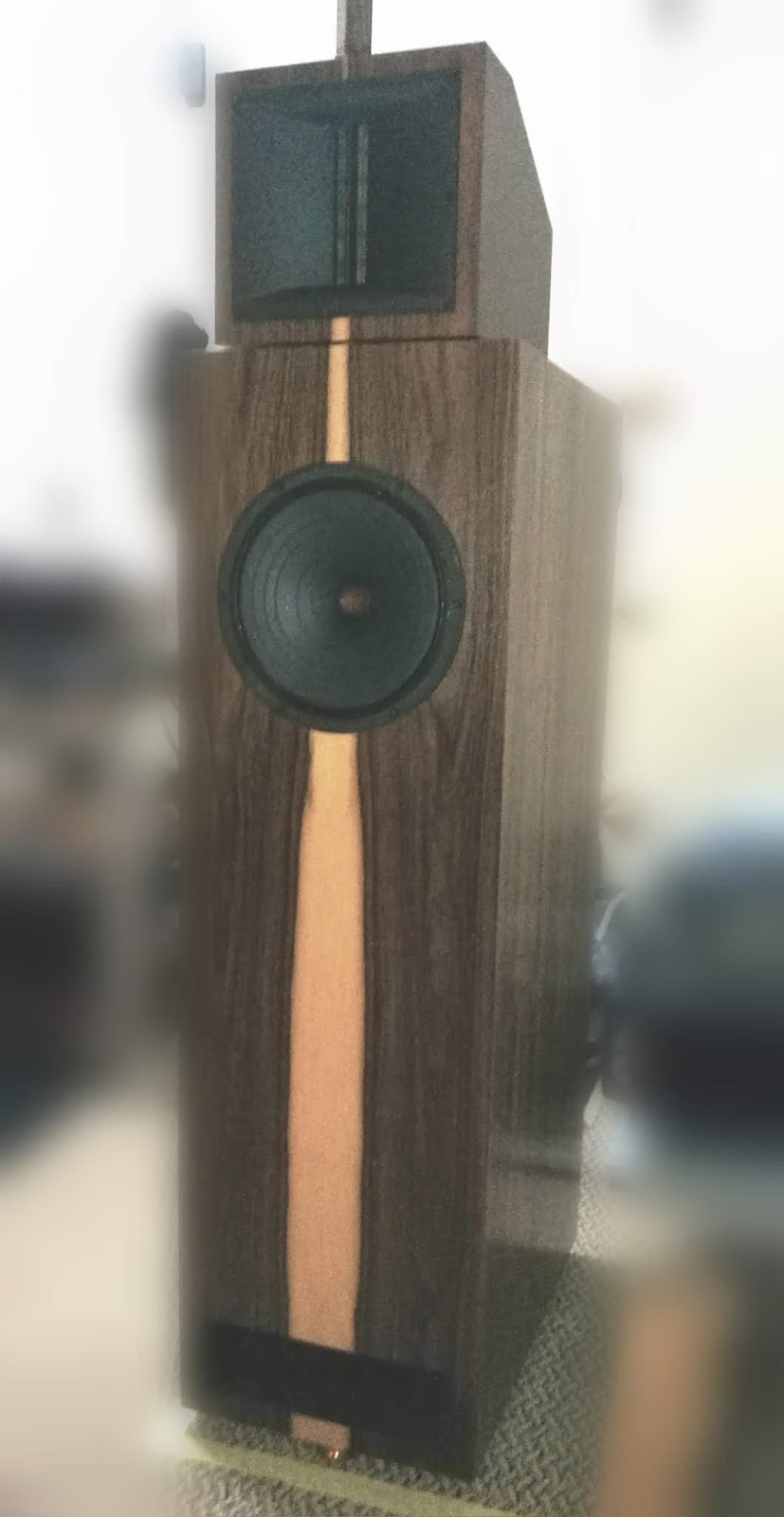
Belle comprises of a pair of super tweeters and main towers. Ribbon super tweeter is my choice for their wide dispersion. Not dynamic super tweeters, the beaming, the pistonic character will attract attention. The point is, super tweeter is to aid space and ambience, nothing more. Due to ageing, there's a good chance that we couldn't hear things above 12kHz when we hit 50. Consequently, by moving the phase issue way up above my audible range, it will not be an issue.
The real battle begins when getting Belle to sing. Never take on a system set up lightly, it's not something you do every day. At the lower end of high efficiency at 93db/W/m sensitivity, I called YBA 1 Alpha for duty, a sweet 85wpc amp that sounds anything but a solid state amp. It took 2 weeks of going back and forth on speaker positioning my room allows. It's a tiring exercise and frequent sonic memory retrievals. I settled on a speaker positioning that best accommodates my parameters.
A sound of the milk and the honey? I'm afraid not. I'd described Belle a shrew citing her annoying peakiness. Sound wise, say hello to a no-frills sound and brutally honest. No Kathoey, a transsexual in Thai, I'm not fine with that. For the sake of timbre uprightness, I swapped in the warmer interconnects and power cords to get the balance right. Even though she posts no standing waves in my room, it's a deal breaker for what she sounds. Rolled up my sleeves, I worked on her peakiness. Mind you, there are no perfect speakers money can buy. For all I know, Belle is the first of her kind ever made here.
Before long, her lively demeanour grabs my attention. Gets up and goes, there's a sense of readiness to sing and supercharging the music. Instruments are the beneficiary, receiving the dire immediacy. I have little patience waiting, the drags kill the music. Lazy sounding puts me to sleep.
In no time, I heard details I never realized existed, a lot of them. Details without articulation are not going to impress any audiophile. Fuzzy notes have no place in high fidelity. I could visualise the virtuoso's actions on the strings. The clarity and radiance of the piano notes lingering in the air and filling the space up. The rapid exchanges of guitar notes, the dark tones of the cello, the icy metallic of the trumpet, it's unlike listening to boxes! The second prize, the sharp staccato of the snare drum is vivid. In my book, the drums and the piano get my vote for the most difficult instruments to reproduce.
Music minus dynamics is zombie. Lifelike dynamic vitalises the music. Even on voices, the vocal dynamic range requires dynamic for the delivery. In this aspect, full range speakers take dynamic like a duck to water, exceeding any multi-driver speakers I heard. The lightness of paper cones and the speaker efficiency work their magic on me, paper cones sounds natural. They seize musical fireworks and rapid exchanges.
Horns have a synonym for relaxed sound. The effortlessness gives gracefulness to the sound, the music still packed with punches despite the sound streaming out from the boxes, not those blows to the stomach. There aren't any. This quality is distinctive, the sound is uncompressed.
Belle is my second stint at crossoverless speaker. A total loss for the first one. I can't stand sonic veil. Take two to tango, a passive preamp and crossoverless speakers, my secret combo. Both do little to tamper the signals. Prepare for tone variations, hue and gradient, they underscore the richness of sound. I was spooked by the midrange presence and vocal pitch modulations. Without reservations, vocal is an easy pie for Belle.
I know, I know, the soundstage is relative to the room size. Comparably, Belle throws a wider soundstage. Lateral soundstage brings separation, not quite the SET three-dimensional magic. Belle hits me right in the feels. With my solid-state amplification, Belle manages a two-point five dimensional presentation. To be honest, Belle produces the best soundstage ever heard in my room. The room, apart from isolating the noise from both internal and external, I'm leveraging on it for room gain. Let's not be fooled, bass is never a strong feat for any full range speaker. I got Belle down to mid 40Hz. By today's standard, it's really nothing to shout about.
Now, the downsides. Mainly the harshness, the peakiness. Secondly, she is incapable of the orchestral splendour, pop and rock. She goes into a panic mode with a string of busy and noisy passages, things get gummy. Housed in a TQWT, the bass is smooth and tuneful, not much in her tank to do the heavy beating. She starts coughing. Forget about midbass punch, nope, I'm not getting any. Bass and full range speakers are not the best of friends. Without super tweeter, the restricted bandwidth will be obvious. Lastly, a restricted playback volume. That is my least worry because Belle plays loud enough in my room.
I'm well aware that audiophiles are preconditioned to new sound after a new introduction into a system. Moreover, the ecstasy clouds our sonic assessment. That's why it's so difficult to write this. On music genres, I say Belle 100:0 on vocal and chamber music, 30:70 chances on pop, 60:40 on jazz, 10:100 on rock music. 20:100 on big symphony works.
I don't wish to paint a rosy picture, the stock Belle isn't going to float many's boats. To arrive at this performance, there are three caveats involving some changes to the speaker fundamental, a carefully aligned super tweeter, phase plug and port tuning. For me, Belle has broken new ground, ushering a new chapter to my audio journey. All the above measures taken see a big step up in sound. She's going in line with my "high impact, low cost" aspiration. True in this regard, less is more, quality over quantity. I'm satisfied. I'm not missing my pre-loved. It will be my end speaker but my friends are not convinced.
Monday, December 3, 2018
A new prince?

Ding dong ding dong, Christmas is less than a month to go. Boy! I love Christmas as we wind down the year. A shopping season has begun, yeah. Look what I've just bumped into; A new prince is born? Buchardt Audio S400. Now, I know that audiophiles are far from comprehensibly agreeable in any audio matter. Nevertheless, this's a small young company from Denmark founded by a young man, 30 years old Mads Brogaard Buchardt has rocked the audio media. No a lot of information to be found on their website; Buchardt Audio. To be honest, what they do isn't any different than the rest, designed in Denmark, outsourced the box manufacturing to China, assembled the speaker in Denmark and sells directly to the consumers worldwide. They are smart not to have the total assembly in China to prevent the design being copied and sell parallelly in another brand. To ship to the consumer worldwide, a home trial for 30 days and free return shipping if you're not happy, I'd say they are rather bold and risk-taking because there'll be some fellas who are not serious about ownership and take a free ride. Shipping isn't cheap and not to mention the heavy administrative work.
Well, being a new company you need to be bold and take chances, what more competing in an overcrowded and highly competitive market segment. They are head-on with the big boys with a global dealer network, KEF, Pro Ac, B&W, ATC, Harbeth, Dynaudio, Elac and others, to name a few. So, Buchardt Audio has to bang on excellent price-performance to beat the odds to chip away a slice of the market share. For all we know, the world will always have a place for high price-performance products. I'm a proponent of such product due to my upbringing, not everyone born rich. Nothing brings more excitement than this.
Strange enough, Buchardt Audio S400 resembles Amphion Argon 3S design in similar fashion, both spot a Constant Directivity Control waveguide tweeter, Buchardt sport a 6 in mid/woofer driver while Argon 3S a 6.5 in, both utilise a passive radiator except the placement of tweeter-mid/woofer driver. Both are the mirror image of each other. S400 employs silk dome tweeter, Argon Amphion Argon S3 titanium tweeter. See the price advantage when you cut the middleman, the bulk of saving goes to the consumers.
 |
| Buchardt S400, USD1895 per pair |
 |
| Amphion Argon S3, USD2795 per pair |
Buchardt Audio S400 was officially debuted in North West Audio, England on 23 Jun 2018. Looks really cool in black, a 0.74 in soft dome tweeter in CDC aluminium waveguide, a 6 in aluminium mid/woofer driver and 5 in x 9 in passive radiator in a 365 x 180 x 240 mm box. Speaker impedance is rated at 4 ohm, frequency response to range from 33 - 40.000 Hz +/- 3db. The figure is rather optimistic. Each speaker weights at 9kg. Buchardt Audio even published some measurements for the freaks, if you know what they mean in sound. No, you don't.
 |
| Crossover components, air coil inductors |
Here's a teaser: https://www.facebook.com/685855514768848/posts/2068275149860204
Google Buchardt Audio S400 on youtube, there are some satisfied user reviews there. One of them even went as far to say S400 competes favourably against with Joseph Audio Pulsar with a MSRP USD7700, USD1895 per pair Buchardt Audio S400 is nonetheless super value. If my memory serves me well, Joseph Audio Pulsars were played in KLIAVS many years back in JW Marriot Hotel, they were driven by Gato Audio AMP-150 then. That system imaged like crazy, what more with a high-end sound to boot.
 |
| CE certification |
Saturday, November 17, 2018
Going gaga with PMC Fenestria

16th Nov 2018, I was cordially invited to the launching of PMC Fact series top of the line speaker, Fenestria at AV Design, the Malaysian distributor in downtown. My curiosity has got the better of me, I want to hear what Fenestria has in store and how its technologies have brought real improvement to the sound. If it's just an evolutionary refinement, I probably give it a pass.
From Fenestria design perspectives, they mark quite a departure from the conventional Fact series design. Not hard to see Fenestria was designed from the ground up, the attention to detail was unprecedented. Well, I'm not actually a new kid to audio, and neither an old dog. Arf-arf, you can't teach old dog new tricks. Likewise, I've certain expectations of what's to come. Paul Bayliss, PMC Business Development Manager revealed that the new creation has taken 5 years of research and development. Oliver Thomas, the son of PMC founder, Peter Thomas who has had a short stint at motorsport had his touch on the design, incorporated some techniques he learned from motorsport, particularly in the area of vibration control and aerodynamics. Audiophiles know resonance induces distortion too well and is unkind to music reproduction. New blood with new ideas, it's good for innovation. Drum roll, please... Fenestria is the fruition.
The physique of Fenestria is imposing, standing tall at 67-inch. The side concave phenolic panels on the speaker apart from visual effect making the speaker look wider or otherwise, a boring slim tall tower. For what it asked, it'll be a tough sell for the targeted consumers without the aesthetic appeal. Audiophiles who spend this much of money want a good look to exhibit individual taste and class. Killing two birds with one stone, the panels also fend off undesirable acoustic energies from getting to the speaker box. How cool is it that the speaker box breaths in an isolated space of its own. The side panels are detachable, they come in Tiger Ebony, Rich Walnut, White Silk and Graphite option to meet the interior decor requirement. PMC has got the wife acceptance factor covered.
Sonomex, the soft dome tweeters take over from 3.8kHz and upwards. Fenestria assigns the task to the midrange dome to handle 3.8kHz down to 380Hz, this solution accounts for a single driver like characteristic. No phasey midrange. It's a clever decision not to cross frequency in the 1-3kHz range, the most sensitive human hearing range based on Fletcher-Munson study. All highlights have led me to think PMC designs Fenestria around the midrange dome. Sweet.
Both tweeter and the midrange dome are enclosed in a metal enclosure, they're suspended in the air and decoupled from the boxes via silicone dampening. It's basically a baffle-less, a first in PMC history. Carbon fibre flat drivers were chosen for its stiffness, lightness and damping factor, most of all, store very little energy. Luminair assisted box houses two 6.5-inch drivers in the respective box, two individual boxes are arranged in mirror image of each other for bass production. Not missing out the massive crossover, hidden in a suspended plinth, another first in PMC too. Besides, the user could adjust tweeter and bass output to cater for different room requirement.
Phew! With all the groundbreaking technologies out of the way, we're interested to know if the sound measures up. But before that, let me quickly run through the system set up. The front end comprises of TAD D600 cd player and Bryston music streamer, TAD C2000 and M2500 amplification, connected via Wywire cables. (I hope I got the components right). The room is treated with GK Acoustics bass traps and all round vertical maple diffusers. The system synergy was good. Quite often you find a dealer succumbed to using the brands he carries to conduct a demo, well, a compromised synergy that couldn't pull off the demo convincingly sometimes. AV Design didn't make that mistake, they managed a successful showdown. Applause, gentlemen. It didn't go unnoticed that the system was meticulously set up by Joseph Ki. Paul told me that Joseph was using a laser guide to speaker positioning with an uncompromising tight tolerance. Image what you'll get with the tweeters precisely levelled, a phenomenon occurs. Good thing doesn't come easy. The guys behind the work deserve the credits.
Holy cow! The first thing that makes me go gaga was the mids when it breaks the silence. From a psychology view, my intuitive reaction in a way reflects my very own midrange deficiency. Pity me. Astonishingly, Fenestria mids blew me away with unprecedented openness, purity and cleanliness. Topping it all off with the right amount of meat to the bone, surprise, surprise. No nasality or cupping was audible. Remarkably free of box colouration even though technically speaking, it is housed in an enclosure. The sound is uncluttered to establish a class on its own. The vent on the enclosure is the key, it resolves the internal pressure build up. The reason is obvious as to why PMC uses the 6.5-inch driver and not any bigger driver as most audiophiles would want, its sound priority is to attain an impeccable coherency in the time domain. I weight coherency over wide-bandwidth, think the timeless Quad ESL-63 in that line of the speaker. What I heard was a sound with adequate warmth and a top to bottom seamless-ness, and with bass. Magnificent.
Upon up-close observation, I couldn't detect the driver aggressive excursion nor much air gushing out from Laminair during the playing. The bass was clean, taut and zippy to produce an overall dynamic presentation. On heavy orchestral pieces, the bass was well behaved and room-filled although I found slight standing waves and cloudiness at the front row seat, approximately 10 feet from the plane of the speakers. You get a bassy presentation seated too low. Anyway, the front row seat isn't great to my ears, too close to the speakers and too low in ear height. I lost a little of the highs intensity at off-axis listening too. OK, I'm being overly critical. Nevertheless, the bass punched above its weight in terms of power thanks to Advanced Transmission Line, one of the PMC proprietary technologies.
Peter, Paul and Mary's Puff the Magic Dragon and Shanondoah sang by don't know shone, the amount of low-level detail and ambience captured in the recording were well retrieved, not to mention the difficult Cantate Domino that Joseph had picked to play. The man must have done his homework. The cathedral ambience was vivid and surreal as if the priest asked me, "Do you like the sound?" "Without hesitation, I do." In turn, albeit with lesser fidelity material, James Tan played pop rock materials, the real man music with greater audience appeals. I couldn't find fault with them. How I wish that Fenestria could punch a little more and then again, didn't you know audiophiles know nothing about greed? Alas, I'm comparing them against speakers twice or thrice the price. In all fairness, Fenestria wasn't fully broken in. There's some hardness to sound that nothing a prolonged playing couldn't make them go away.
The above listening impression comes with a caveat, as I already mentioned, the seating position must be spot on. If these criteria are met, you'll be rewarded with a breathtaking sonic holographic, lateral and front to back layering if you get what I mean. Forget about big sweetspot, there's only one throne in the house. Moving forward, you kind of know a person sonic presentation signature if you heard long enough. Mine will be different, I've no doubts yours too. All of us are inclined to emphasize certain sonic features. Our set of priorities are different that makes audioing interesting.
To conclude, MRSP RM230K is not a small price. There're a number of competing speakers in a similar price range and it's an investment to think through and through. Nevertheless, Fenestria is high in my speaker wishlist if I have the money. It's a big IF, I'm a poor guy but James agreed to sell one speaker and the other when I save enough. What presents before me is a pair of speaker that's easy, almost too easy to get a decent sound out of the box, none like the frustrating four towers speaker system. What's more, Fenestria presents an easy load on the amplifier. I stick my neck out saying this, Fenestria has a midrange to die for. And now the dust had settled, I feel disheartened to return to my midrange.
Monday, May 22, 2017
Oriental cousin
Unpredictable, we aren't having rain in April and May in the past, neither we see our currency at all time low against major currencies. Most unfortunately indeed, every import becomes more pricey than ever. I sigh at my falling spending power, my daily meal cost has increased considerably. We have everything to worry about. So, the talk of two jobs is no more a joke in the future, very near future. What more the cost of medicare when age catches up? I wish not to be bled dry financially in my old days, really.

Years of system optimizing, I am delighted that my system has achieved so far. My hearing sharpened in the course of tweaking. I hold true to the principle that "stay status quo whenever in doubt, come back later". While my speakers are not of blue blood, they do many things well, perhaps too well in many respects for their asking price, of course. What can I say, audiophiles, in general, have little respect for a mass market brand, they are entrapped by the brand perception. I do not bother with branding, because value speaks louder to me.
S1-EX strikes a chord due to its well-balanced tonal balance, fairly close to character free. Magnesium midrange driver introduces a very clean midrange. It offers no exception to the rules, the paper driver still reigns supreme in emotional connection. The Beryllium tweeter confined in the midrange driver is relatively reserved, not something I'd expect given 100kHz on the paper. Anyway, Pioneer engineers did a remarkable job marrying all the drivers and maintained in phase. Try as hard as I could, I couldn't discern the crossover point, perhaps my aged hearing didn't do justice to the task. Coherency ranked high in my audio priority, I subscribed to "lesser driver, lesser issue". Having said so, I didn't get caught by surprise that Kalman Rubinson, the Stereophile reviewer felt like listening to flat speakers. From my own experience, I couldn't agree more. Did I sound like self-boasting?
Point source is a brilliant idea, a speaker wisdom from the past. This design kills two birds with one stone, the tweeter nestled in the midrange driver, the membrane of the midrange driver serves as a waveguide to permit single source sound propagating. It handles 400Hz and above, covering the human most sensitive audible frequency range. In comparison to conventional speakers where the tweeter and midrange drivers are separately located, the sound varies to the ear height when seated, more so with a stand-up and sit-down listening.We have got different listening heights.
While so far so good, I'm not without any qualms. My goodness, fresh aramid, carbon fiber and polypropylene composite bass drivers are tight and take forever to break in. Before I come to the bass performance, I'd like to draw your attention to the bass character. Metal bass driver and paper bass driver represent the two extreme bass character, the former is fast, lean, clean, tenacious while the latter is warm, fuller, sluggish and unprecise. S1-EX sits in the middle ground. S1-EX bass deficiency really bothered me before break in, there isn't any meat to the bone, in which led to a recessed mids. This is not a speaker that sings like a canary out of the box or even 1000 hours on them. To remedy this, I did lots of bass enhancement and hours on them to get the bass back up. On the upper end, the highs are reserved even though they claimed of reaching 100kHz. It somehow renders a more civilized, poised and refined demeanor, a very precious asset indeed. The harsh, coarse highs and constantly calling attention to itself top the list of irking you. For me, it is easy to enhance the highs than to tame it. Having said that, to uncolor the speaker is an arduous task that often doesn't pay, a silly idea I must say so. You never know what you will get yourself into. There goes my wishlist, not a perfect specification fit speaker though, but easier to work around to attain my sound goal. Be realistic, the sonic anomalies surface with the room nodes, they will derive the sound from what it should have been. You need to try a few cables on them, the least and room treatment to get what you wanted.
Everything falls into the right place once the bass drivers loosen up, eventually. My tuning has been to facilitate a more conducive listening environment. Not forgetting, adding a healthy dose of spark to give life. S1-EX loves to be driven hard, it was designed for AV at heart. Bass volume shouldn't be the Achille's heel. The bass becomes profoundly gratifying after two Frank Power Banks came to aid, they mark a milestone transformation. I am sinking in the energy sensation, loving it.
Energy/power, resolution and dynamic, S1-EX excels without skimping the emotive department. This is a three years culmination of my work. Says who? Our natural intuition to sound is astoundingly accurate, I often benchmark it against live performance. What measures well doesn't necessary sound good. If otherwise, why undergoing subjective listening if the measurements can fill the bill? Food for thought.
Lastly, buy a speaker to your room size if you don't intend to wage a war against room acoustics. This is a battle you have little chances of winning.

Years of system optimizing, I am delighted that my system has achieved so far. My hearing sharpened in the course of tweaking. I hold true to the principle that "stay status quo whenever in doubt, come back later". While my speakers are not of blue blood, they do many things well, perhaps too well in many respects for their asking price, of course. What can I say, audiophiles, in general, have little respect for a mass market brand, they are entrapped by the brand perception. I do not bother with branding, because value speaks louder to me.
S1-EX strikes a chord due to its well-balanced tonal balance, fairly close to character free. Magnesium midrange driver introduces a very clean midrange. It offers no exception to the rules, the paper driver still reigns supreme in emotional connection. The Beryllium tweeter confined in the midrange driver is relatively reserved, not something I'd expect given 100kHz on the paper. Anyway, Pioneer engineers did a remarkable job marrying all the drivers and maintained in phase. Try as hard as I could, I couldn't discern the crossover point, perhaps my aged hearing didn't do justice to the task. Coherency ranked high in my audio priority, I subscribed to "lesser driver, lesser issue". Having said so, I didn't get caught by surprise that Kalman Rubinson, the Stereophile reviewer felt like listening to flat speakers. From my own experience, I couldn't agree more. Did I sound like self-boasting?
Point source is a brilliant idea, a speaker wisdom from the past. This design kills two birds with one stone, the tweeter nestled in the midrange driver, the membrane of the midrange driver serves as a waveguide to permit single source sound propagating. It handles 400Hz and above, covering the human most sensitive audible frequency range. In comparison to conventional speakers where the tweeter and midrange drivers are separately located, the sound varies to the ear height when seated, more so with a stand-up and sit-down listening.We have got different listening heights.
While so far so good, I'm not without any qualms. My goodness, fresh aramid, carbon fiber and polypropylene composite bass drivers are tight and take forever to break in. Before I come to the bass performance, I'd like to draw your attention to the bass character. Metal bass driver and paper bass driver represent the two extreme bass character, the former is fast, lean, clean, tenacious while the latter is warm, fuller, sluggish and unprecise. S1-EX sits in the middle ground. S1-EX bass deficiency really bothered me before break in, there isn't any meat to the bone, in which led to a recessed mids. This is not a speaker that sings like a canary out of the box or even 1000 hours on them. To remedy this, I did lots of bass enhancement and hours on them to get the bass back up. On the upper end, the highs are reserved even though they claimed of reaching 100kHz. It somehow renders a more civilized, poised and refined demeanor, a very precious asset indeed. The harsh, coarse highs and constantly calling attention to itself top the list of irking you. For me, it is easy to enhance the highs than to tame it. Having said that, to uncolor the speaker is an arduous task that often doesn't pay, a silly idea I must say so. You never know what you will get yourself into. There goes my wishlist, not a perfect specification fit speaker though, but easier to work around to attain my sound goal. Be realistic, the sonic anomalies surface with the room nodes, they will derive the sound from what it should have been. You need to try a few cables on them, the least and room treatment to get what you wanted.
Everything falls into the right place once the bass drivers loosen up, eventually. My tuning has been to facilitate a more conducive listening environment. Not forgetting, adding a healthy dose of spark to give life. S1-EX loves to be driven hard, it was designed for AV at heart. Bass volume shouldn't be the Achille's heel. The bass becomes profoundly gratifying after two Frank Power Banks came to aid, they mark a milestone transformation. I am sinking in the energy sensation, loving it.
Energy/power, resolution and dynamic, S1-EX excels without skimping the emotive department. This is a three years culmination of my work. Says who? Our natural intuition to sound is astoundingly accurate, I often benchmark it against live performance. What measures well doesn't necessary sound good. If otherwise, why undergoing subjective listening if the measurements can fill the bill? Food for thought.
Lastly, buy a speaker to your room size if you don't intend to wage a war against room acoustics. This is a battle you have little chances of winning.
Monday, September 14, 2015
Poor man's consolation
Struck by the throat infection, I lost my voice for the past two weeks. When every speech becomes so difficult, food poisoning followed, damn! A string of bad luck.
It seems nothing good going on in the country. Ringgit is plummeting to historical low, it didn't really benefit the country much amidst bleak global economy. Weak demand, raising costs coupled with increasing unemployment, the sign for stagflation is ever clearer. A worrying scenario with high household debt to trigger non-performing loan. Falling foreign reserve and high national debt, well, these does not give much leeway for fiscal policies to wield measures as economic stimulus. The bottom line, we have got less to spend.
Retail business will be first to take a toll. Food and beverage business is close behind. Real estate business good days are over given tightening of loan and weak demand. Audio business is going into a crush time especially low and mid end. Big boys (high end audio) shouldn't be affected because they have the cash and hardly bothered by bills. Pre-owned audio market becomes hot, you will find your stuff if you are patience enough.
I got a question for you folks and I will be specific. Given a budget of 30 grand on a speaker and assuming you love both sounds, which will you opt; a flagship model from mid end audio or an entry model from a high end audio? Question is simple enough but I'm sure to get interesting answers.
As of almost all things in life is cruel, the world recognizes one winner. Winner takes all. And there will always be only one winner but not in audio. Ask audio folks a question, you get many different answers. Meritocracy is the only standard. Merit is the gold standard, value is sour grape. Hypothetically speaking, if a million USD is required to attain a performance worthy of 9, that's a benchmark. If a system costs half a million dollar attains a 9 only, a new ground is established. And once in a blue moon comes an exceptional product, made it to 9.1 with 1.5 million dollar, we called it a paradigm shift. A new equilibrium is created. Will the 9er system a great value than? High end audio is continuously pushing boundaries of engineering, the price for the competitive edge is steep.
Merit alone, Usain Bolt has every right to be cocky because he is the fastest man on earth. Who care about the second fastest man? Who care about the dancers in Michael Jackson concert? Who care about the original song writer? Who care the chef who prepares the food? Who will remember which system has the best bang for the buck? Get what I mean?
Trouble is if you spend that kind of money and didn't get the deserving result, your system is deemed under performed. It hurts! This is like food stuck in the throat and stomach. Hard to hide the fact, the news travels. There are times that words could not contain bad or undesirable meaning no matter how you phrase it like how a doctor telling his patient that he is dying soon? And silence sometimes is the best thing ever. Unless one is in a state of denial, you could not lessen the damage. Two options left either you step up or admit defeat and bite the bullet.
Value is a person's perspective on importance of certain object. Value is actually a poor man's consolation! Because to put a value on a performance subject to undefined parameters, it is not doable. How would a milled enclosure from aviation grade alumium block improve the sound? How much would a crazy resonance free rack improve the sound? Aviation alumium as speaker enclosure material, how would this technology helps? I choose to be different. I am less bother with your cost of your system but examine how little wrong as a whole, how realistic is your replay.
It isn't difficult that most mid end folks tend to put heavy emphasis on tonality whilst the high end folks stress on power and dynamic. Both are not on the same page to begin with. Wouldn't it be good that folks comparing apple with apple? Not stepping on foreign territory, everybody is happy.
So, my answer to my question is return to the basic, how little wrong with the speaker. Things like openness, balance, coherency and dynamic are the parameters that do not changed over the time. The launching of entry models from high end companies is only to capture folks that "sworn by brand". In marketing term, it is called brand leveraging. There is a strong advice that only from the upper middle level from the lineup of a high end brand worth its salt where you get what you pay for.
Mid end audio will go for broke packing a lot of attention to cement its presence in upper echelon audio. It is a do or dies thing. I have my doubts on offerings from non-traditional speaker company, unless some established speaker designers behind the picture. Building speaker is more complex as it involves acoustics, electrical and electronic. Remember the catchword, speakers that measure well do equate to good sound? If computer aid speaker designing tool could do the job, we will not need speaker guru and listening panel. Measurement does tell everything.
So, choosing the right speaker is an important decision in building your system. Commit to your choice and make them work.
It seems nothing good going on in the country. Ringgit is plummeting to historical low, it didn't really benefit the country much amidst bleak global economy. Weak demand, raising costs coupled with increasing unemployment, the sign for stagflation is ever clearer. A worrying scenario with high household debt to trigger non-performing loan. Falling foreign reserve and high national debt, well, these does not give much leeway for fiscal policies to wield measures as economic stimulus. The bottom line, we have got less to spend.
Retail business will be first to take a toll. Food and beverage business is close behind. Real estate business good days are over given tightening of loan and weak demand. Audio business is going into a crush time especially low and mid end. Big boys (high end audio) shouldn't be affected because they have the cash and hardly bothered by bills. Pre-owned audio market becomes hot, you will find your stuff if you are patience enough.
I got a question for you folks and I will be specific. Given a budget of 30 grand on a speaker and assuming you love both sounds, which will you opt; a flagship model from mid end audio or an entry model from a high end audio? Question is simple enough but I'm sure to get interesting answers.
As of almost all things in life is cruel, the world recognizes one winner. Winner takes all. And there will always be only one winner but not in audio. Ask audio folks a question, you get many different answers. Meritocracy is the only standard. Merit is the gold standard, value is sour grape. Hypothetically speaking, if a million USD is required to attain a performance worthy of 9, that's a benchmark. If a system costs half a million dollar attains a 9 only, a new ground is established. And once in a blue moon comes an exceptional product, made it to 9.1 with 1.5 million dollar, we called it a paradigm shift. A new equilibrium is created. Will the 9er system a great value than? High end audio is continuously pushing boundaries of engineering, the price for the competitive edge is steep.
Merit alone, Usain Bolt has every right to be cocky because he is the fastest man on earth. Who care about the second fastest man? Who care about the dancers in Michael Jackson concert? Who care about the original song writer? Who care the chef who prepares the food? Who will remember which system has the best bang for the buck? Get what I mean?
Trouble is if you spend that kind of money and didn't get the deserving result, your system is deemed under performed. It hurts! This is like food stuck in the throat and stomach. Hard to hide the fact, the news travels. There are times that words could not contain bad or undesirable meaning no matter how you phrase it like how a doctor telling his patient that he is dying soon? And silence sometimes is the best thing ever. Unless one is in a state of denial, you could not lessen the damage. Two options left either you step up or admit defeat and bite the bullet.
Value is a person's perspective on importance of certain object. Value is actually a poor man's consolation! Because to put a value on a performance subject to undefined parameters, it is not doable. How would a milled enclosure from aviation grade alumium block improve the sound? How much would a crazy resonance free rack improve the sound? Aviation alumium as speaker enclosure material, how would this technology helps? I choose to be different. I am less bother with your cost of your system but examine how little wrong as a whole, how realistic is your replay.
It isn't difficult that most mid end folks tend to put heavy emphasis on tonality whilst the high end folks stress on power and dynamic. Both are not on the same page to begin with. Wouldn't it be good that folks comparing apple with apple? Not stepping on foreign territory, everybody is happy.
So, my answer to my question is return to the basic, how little wrong with the speaker. Things like openness, balance, coherency and dynamic are the parameters that do not changed over the time. The launching of entry models from high end companies is only to capture folks that "sworn by brand". In marketing term, it is called brand leveraging. There is a strong advice that only from the upper middle level from the lineup of a high end brand worth its salt where you get what you pay for.
Mid end audio will go for broke packing a lot of attention to cement its presence in upper echelon audio. It is a do or dies thing. I have my doubts on offerings from non-traditional speaker company, unless some established speaker designers behind the picture. Building speaker is more complex as it involves acoustics, electrical and electronic. Remember the catchword, speakers that measure well do equate to good sound? If computer aid speaker designing tool could do the job, we will not need speaker guru and listening panel. Measurement does tell everything.
So, choosing the right speaker is an important decision in building your system. Commit to your choice and make them work.
Monday, August 3, 2015
Secret Audio
Prejudice exists under your nose even though you deny it. What can I say? It's human nature. Studies shows it has strong correlation with poor perceptions arise from negative past experiences, poor reliability and superiority complex. The latter is guilty without a fair trial. I supposed the world is shaped that way; quick to draw conclusions.
It takes a mammoth effort to change perception. Japanese sound was long associated with shrill, thin, dry and unnatural sound not until the birth of Accuphase, Kondo, Reimyo, Zanden, Wavac, Koda and alike. Their remarkable sonic achievements now rival the world's best if not the best.
A strong socio-economic is the backbone of a nation well-being. A nation with high income per capita will naturally have higher standard of living, and hence high spending power. Developed nations will talk about liberalism, human rights, environment preservation, cultural preservation, high quality education, high morality, consumer rights, intellectual properties and so far so forth. White supremacy is still very much alive. As such, China is generally regarded as the victim of superiority complex for its battered image. Chinese products still have an uphill battle to combat bad perception, they are considered low tech and cheap. Things are slowly changing though at a snail's pace. Auralic, Lumin, Dussun, Opera, Shanling, Eastern Electric, Lenovo, Xiaomi, Li Ning among others are leading the charge.
Secret Audio is a pleasant find at KLIAVS2015. My first visit at approximately 1.30pm to have found its room was locked and it aroused my curiosity, which the room has secrets to unveil. Probably. My second visit on the same day found no visitors in the room, I had the room by myself. The chat with the designer was informative and Mak, Secret Audio honcho tell me how he sets his products from the rest. Cheap is something you don't expect from him. Ahem, so it seems I have had a slip of memory. I recalled listening to Mak's 211 SET monoblocks at Alan's place last year around the same time. Secret Audio as its name implied, is low profile, based in rather remote Zhong San Wu road in Guangzhou. Mak puts a lot of emphasis on neutrality and transparency. On LC One debut, he was honest to reveal that he uses monitor speaker as reference to work on his creation. Without a reference, you are without a compass in the wilderness, that's how it is.
I cheekily posted a question to Mak with regard to Chinese sound. Does China have a distinctive sound (in a bad way)? He was caught off guard, saying Chinese sound is of audio products made in China. Well, China is a big country and you'd expect some good and shitty products from there. Anyway, my general impression of Chinese sound has been rounded highs, fuller mids and laggy dynamic, a perfect recipe for vocal reproduction. On one occasion, I had heard a pair of unknown Chinese made bookshelf speakers with even tonal balance and awesome transparency that rivals five times its price from overseas. They were asking for RM10k per pair then.
Buying audio products is putting the money where your mouth is, is concurring to the designer's taste. That's the reason we visit audio stores to check thing out instead of reading reviews. Reviews are written by audio critics you might have no clue of what are their preferences. It comes as no surprise to me that many might have missed Secret Audio room at KLIAVS 2015. Boutique audio, because they are small, because they are unknown and most of all, because they are from China. Let's be honest, audiophile purchasing decision weighs heavily on brand and aesthetic. A local dealer also shared similar rants, tough business. Eye fi is a common audio chronic disease among audiophiles who place brand and aesthetic before sound, seeing allegiance to mainstream audio, with intensive advertising and review coverage. Factory direct has little leverage to compete with the big boys.

Mak premiered Secret Audio, LC Ones at its maiden KLIAVS 2015. Boxed up in a conventional right rectangular prism, boxy LC One looks ordinary, resembling a smaller version of Spendor SP100 R2, eradicating the top 7 inch midrange driver. No exotic materials, but good old plain MDF.
System setup
His system was simple, an old Studer studio CD player, Secret Audio 50 watt push pull tube integrated amp, a pair of LC One speakers and hooked up with ordinary cables. LC Ones were listened with the super tweeters. Room size was 430 square foot, usable audio space is approximately 16 foot width, 20 foot length and 10 foot height. Thing can't get any simpler than this.
Listening
Without further ado, let check out LC Ones demeanor. Mak played a variety of music to satisfy my inquisition. Voices, he popped in the late Roman Tam's 亲情, a Cantonese hit from the 80s soap. It was a nostalgic experience. Roman Tam's trademark; a powerful voice and crystal clear articulation. On this number, Roman Tam was supported by an orchestra. I remarked not overly liquid voice, transparent, well separated and enormous soundstage. Come on, you got to be kidding me, in show condition with no treatment? They shamed many more expansive systems in the show. Beside, Roman head movement was captured in the play.
On Cai Qin's slow number, in close miking studio recording, she appeared to be in a right size, more linear and meatier presentation. They don't do the voices like the BBC, which with added colorations. Perhaps, not as razor sharp imaging capabilities of small mini monitor. In imaging department, I'd give a vision power of 50/50. Cai Qin's stature was projected to be about 5 foot.
Next up, 2015 Commemorative CD 小曲儿. This Chinese ethnic dance piece is a good stress test for tweeter resolving and handling power. LC Ones employ the mid-priced Seas silk dome tweeter, not Excel series. I thought the gain of the recording was greater than usual. Still, Mak cranked it up, the highs were well behaved and blend seamlessly to upper mids. Unlike the ultra-resolving Beryllium tweeters, you need to be careful with the matching components and cables to prevent all hell breaks loose. 点到即止。
Mak threw in a chorale work to further demonstrate the resolving power of LC Ones. Due to the scale and width, chorale is one hard nut to crack. The whole audio chain is under examined. No gluey heads thank you, the hall ambiance was unmistakable. I was transported to mid row in a music hall. Not too laid back. At this juncture, LC Ones were found catching breath at fortissimo during the strenuous crescendo, they like to be driven hard but the partnering amp ran out of steam. Mak furthered LC Ones are best driven with solid state electronics of 100 watt and above.
"Give me some piano." I asked Mak. Piano is my favourite test piece. Ill-designed speakers have no chance surviving this. Beside tonal correctness, the vibrancy of strings, the sustain and resonances are what makes piano piano. Inevitably, tube amp softens the stringy and lessens the "masculine" from 80Hz and below.
A listening is not complete without classical music. LC Ones are fast, I thought there wasn't any bass energy below 50Hz. There wasn't any bass overhang to muffle the lower mids which itself is a good thing. The orchestra was expansive with remarkable ambiance retrieval. There was neither any confusion moving section to section. Neutrality paid off, preserving the natural color and timbre richness of the instruments.
Conclusion
You could tell that I like LC Ones. Priced at slightly less than RM10k, they are met with fierce competition. Harbeth Monitor 30 naturally comes into my mind. Needless to say, LC Ones are fighting an uphill battle with both speakers competing in different areas. LC Ones are more neutral, relaxed, extended, open and transparent while Monitor 30 has a clear edge on voices and fuller mids. Both are equally refined and you don't get much refinement below RM10k, either is not a bad choice.
Question is could you live with a Made in China product mental block? The golden advise is 耳听为憑, go with your heart.
It takes a mammoth effort to change perception. Japanese sound was long associated with shrill, thin, dry and unnatural sound not until the birth of Accuphase, Kondo, Reimyo, Zanden, Wavac, Koda and alike. Their remarkable sonic achievements now rival the world's best if not the best.
A strong socio-economic is the backbone of a nation well-being. A nation with high income per capita will naturally have higher standard of living, and hence high spending power. Developed nations will talk about liberalism, human rights, environment preservation, cultural preservation, high quality education, high morality, consumer rights, intellectual properties and so far so forth. White supremacy is still very much alive. As such, China is generally regarded as the victim of superiority complex for its battered image. Chinese products still have an uphill battle to combat bad perception, they are considered low tech and cheap. Things are slowly changing though at a snail's pace. Auralic, Lumin, Dussun, Opera, Shanling, Eastern Electric, Lenovo, Xiaomi, Li Ning among others are leading the charge.
Secret Audio is a pleasant find at KLIAVS2015. My first visit at approximately 1.30pm to have found its room was locked and it aroused my curiosity, which the room has secrets to unveil. Probably. My second visit on the same day found no visitors in the room, I had the room by myself. The chat with the designer was informative and Mak, Secret Audio honcho tell me how he sets his products from the rest. Cheap is something you don't expect from him. Ahem, so it seems I have had a slip of memory. I recalled listening to Mak's 211 SET monoblocks at Alan's place last year around the same time. Secret Audio as its name implied, is low profile, based in rather remote Zhong San Wu road in Guangzhou. Mak puts a lot of emphasis on neutrality and transparency. On LC One debut, he was honest to reveal that he uses monitor speaker as reference to work on his creation. Without a reference, you are without a compass in the wilderness, that's how it is.
I cheekily posted a question to Mak with regard to Chinese sound. Does China have a distinctive sound (in a bad way)? He was caught off guard, saying Chinese sound is of audio products made in China. Well, China is a big country and you'd expect some good and shitty products from there. Anyway, my general impression of Chinese sound has been rounded highs, fuller mids and laggy dynamic, a perfect recipe for vocal reproduction. On one occasion, I had heard a pair of unknown Chinese made bookshelf speakers with even tonal balance and awesome transparency that rivals five times its price from overseas. They were asking for RM10k per pair then.
Buying audio products is putting the money where your mouth is, is concurring to the designer's taste. That's the reason we visit audio stores to check thing out instead of reading reviews. Reviews are written by audio critics you might have no clue of what are their preferences. It comes as no surprise to me that many might have missed Secret Audio room at KLIAVS 2015. Boutique audio, because they are small, because they are unknown and most of all, because they are from China. Let's be honest, audiophile purchasing decision weighs heavily on brand and aesthetic. A local dealer also shared similar rants, tough business. Eye fi is a common audio chronic disease among audiophiles who place brand and aesthetic before sound, seeing allegiance to mainstream audio, with intensive advertising and review coverage. Factory direct has little leverage to compete with the big boys.

Mak premiered Secret Audio, LC Ones at its maiden KLIAVS 2015. Boxed up in a conventional right rectangular prism, boxy LC One looks ordinary, resembling a smaller version of Spendor SP100 R2, eradicating the top 7 inch midrange driver. No exotic materials, but good old plain MDF.
System setup
His system was simple, an old Studer studio CD player, Secret Audio 50 watt push pull tube integrated amp, a pair of LC One speakers and hooked up with ordinary cables. LC Ones were listened with the super tweeters. Room size was 430 square foot, usable audio space is approximately 16 foot width, 20 foot length and 10 foot height. Thing can't get any simpler than this.
Listening
Without further ado, let check out LC Ones demeanor. Mak played a variety of music to satisfy my inquisition. Voices, he popped in the late Roman Tam's 亲情, a Cantonese hit from the 80s soap. It was a nostalgic experience. Roman Tam's trademark; a powerful voice and crystal clear articulation. On this number, Roman Tam was supported by an orchestra. I remarked not overly liquid voice, transparent, well separated and enormous soundstage. Come on, you got to be kidding me, in show condition with no treatment? They shamed many more expansive systems in the show. Beside, Roman head movement was captured in the play.
On Cai Qin's slow number, in close miking studio recording, she appeared to be in a right size, more linear and meatier presentation. They don't do the voices like the BBC, which with added colorations. Perhaps, not as razor sharp imaging capabilities of small mini monitor. In imaging department, I'd give a vision power of 50/50. Cai Qin's stature was projected to be about 5 foot.
Next up, 2015 Commemorative CD 小曲儿. This Chinese ethnic dance piece is a good stress test for tweeter resolving and handling power. LC Ones employ the mid-priced Seas silk dome tweeter, not Excel series. I thought the gain of the recording was greater than usual. Still, Mak cranked it up, the highs were well behaved and blend seamlessly to upper mids. Unlike the ultra-resolving Beryllium tweeters, you need to be careful with the matching components and cables to prevent all hell breaks loose. 点到即止。
Mak threw in a chorale work to further demonstrate the resolving power of LC Ones. Due to the scale and width, chorale is one hard nut to crack. The whole audio chain is under examined. No gluey heads thank you, the hall ambiance was unmistakable. I was transported to mid row in a music hall. Not too laid back. At this juncture, LC Ones were found catching breath at fortissimo during the strenuous crescendo, they like to be driven hard but the partnering amp ran out of steam. Mak furthered LC Ones are best driven with solid state electronics of 100 watt and above.
"Give me some piano." I asked Mak. Piano is my favourite test piece. Ill-designed speakers have no chance surviving this. Beside tonal correctness, the vibrancy of strings, the sustain and resonances are what makes piano piano. Inevitably, tube amp softens the stringy and lessens the "masculine" from 80Hz and below.
A listening is not complete without classical music. LC Ones are fast, I thought there wasn't any bass energy below 50Hz. There wasn't any bass overhang to muffle the lower mids which itself is a good thing. The orchestra was expansive with remarkable ambiance retrieval. There was neither any confusion moving section to section. Neutrality paid off, preserving the natural color and timbre richness of the instruments.
Conclusion
You could tell that I like LC Ones. Priced at slightly less than RM10k, they are met with fierce competition. Harbeth Monitor 30 naturally comes into my mind. Needless to say, LC Ones are fighting an uphill battle with both speakers competing in different areas. LC Ones are more neutral, relaxed, extended, open and transparent while Monitor 30 has a clear edge on voices and fuller mids. Both are equally refined and you don't get much refinement below RM10k, either is not a bad choice.
Question is could you live with a Made in China product mental block? The golden advise is 耳听为憑, go with your heart.
Tuesday, January 13, 2015
Open baffle speaker, anyone?
Despite my growing curiosity of open baffle speakers, they and electrostatic/ribbon speakers to date are secluded from my play list. Emerald Physics was in my mind when I was craving for a certain sound in my last upgrade urge. They are relatively affordable and widebander but I'm not confident that I could pull off dipole acoustic waveform mayhem, besides space constraint is also a limiting factor. Ahem, I don't want to mess around with something too hot to handle, furthermore I don't want to get stuck in a situation "you're neither here or there". And so, open baffle speakers and electrostatic/ribbon speakers were admired from afar. Labelled as cult, there is virtually no open baffle speaker being brought in by the local dealers, not until now.
Speaker is the hardest to get it right. While others working to minimise box colouration, some working the enclosure to reduce colourations. Among others, Dick Olsher, Siegfried Linkwitz, Danny Ritchie and many forerunners in promoting open baffle speaker. Sonic colouration is a bad thing, it is impossible to right the colouration, you wish you'd never have to confront with in the first place. It's like a wrong stroke of brush. Presumably, open baffle speaker's most thoughtful advantage, free of box colouration. In many ways, we're all got accustomed to box colouration and accepted it as a norm. The box-less idea is nevertheless inviting.
Competition is the driving force for the speaker innovation and there is a lot of study on effect of the enclosure. Besides aesthetic, the enclosure needs to sound right. To brace or not to brace, to damp or not to damp, to port or not to port, every aspect affects the sound. It is not difficult to see as you move up the echelons of speakers, the enclosure takes up a lion share of building cost. Hence, less colourations. The aesthetic of speaker reflects the owner's taste, so to speak. Wife acceptance factor also creeps in, she wants a furniture grade enclosure in her majesty the queen's living room. Question you must ask yourself, aesthetic first or fidelity first or how much you should spend on aesthetic and fidelity?
Aviation grade aluminum and bamboo sandwich are both materials the most talked about. As in the discipline of mass production, material workability and reject rate must not be taken lightly. All will raise cost. CAD is a great tool. It helps to reduce speaker development time and cost. It calculates the enclosure volume, but not enclosure shape. The study of enclosure shape has taken place decades ago, Mr Voigt pioneered the complicated Tapered Quarter Wavelength Tube TWQT, the mind boggling Hedlund speaker, various horn configurations, Audio Note insistence on wide front baffle speaker. The French champion sphere enclosure, Wilson with their so acclaimed proprietary resin but rather pedestrian box, Norh speaker employs tree trunk as gong like enclosure. B&W with their scientific Nautilus ceramic tubular enclosure, Kiso Acoustics was inspired by the making of musical instrument, Waterfall Audio with glass enclosure, YG Acoustics and Magico with high tech aluminum enclosure and the late Franco Serblin is most creative with its artisan Accordo, arch shaped enclosure. Accordo looks sexy and sets itself apart from boring enclosure, they are a wonderful piece of art. The list is far from exhaustive. That's what makes speaker the most exciting component, innovations and aesthetic in a single package.
When I chance upon Spatial M1Turbo in town, there's a urge wanting to listen to them as I never have the chance to listen to open baffle speakers.

The front end is Mac feeding Clone Audio Sheva DAC in the dealer room. My short listening impression of Spatial M1 Turbo driven with Clone Audio 25i. If my memory serves me right, the room was 16 feet wide, 24 feet length and 10 feet height and with minimum treatment.
.jpg)
Coincidently, Spatial Audio is founded by the man who co-found Emerald Physics, Clayton Shaw. Both companies have very similar offerings and hence a natural direct competitor. M1 Turbo sports two 15 inch drivers, the top driver is a coaxial design and the bottom driver takes upon 800 Hz and below. What M1 Turbo differs from the conventional open baffle is that they do not have a wide front panel as to eliminate back waves. However, M1 Turbos do require at least 4-5 feet away from front wall to obtain the crucial 6ms time delay of reflected sound. The delayed time helps to recreate depth and sonic decay. The dealer further stressed that M1 Turbos will sound perfectly OK in an untreated small room, bye bye to ugly acoustic panel.
Albeit the dealer claimed that the newly arrived Spatial Quantum Field speaker cables are uncooked, the system sounded unlike anything I've heard before. The short one hour listening experience was an eye opener, given more time, the system will certainly open up more. M1 Turbo was placed out wide with slight toe in. In the dealer room, approximately 5-6 feet from the front wall. I am happy to report that there is no annoying honky that usually associates with coaxial drivers.
The sound I gathered from the dealer showroom is notably different from the conventional speakers. There is a degree of lightness and nimbleness to the sound. Let me tell you what they are not, they do not project ultra precision and hyper details of modern speakers. In another word, not a hi fi-ish sound. No sonic scalpel here but there is something to the sound I can't put my hand on at first encounter. Remarkably less cloudy, the absence of air turbulence throughout upper to lower registers. It sounded like the real thing. Images were lifelike in an enormous holographic soundstage and laid back. They enable a wider audible perspective. In spite of their low demeanour, they are able to project around 5 feet image height admirably. Among the registers, low registers stand out the most being remarkably accurate and natural.
I can't stop quibbling the relatively lacking in details with M1 Turbo. It seems Shaw had already acknowledged it beforehand, he fitted in a pair beryllium tweeters in his ambitious flagship Lumina 12Be Statement Dipole, smacking a walloping price tag USD20k a pair on them.
What M1 Turbos did not measure up with modern speakers, they are more than making up in free of box colouration, lively, ease and natural. My mind was constantly relating how close they sounded to live music. Live radiates omni-directional, dipoles come very close to live. The sound from M1 Turbos didn't sound as if gushing air through a pipe, this is a quality you need to hear it for yourself. I'd love to hear them again with high damping muscular amp, to impose a tighter grip on the music.
I only report the system as when and as where it is and nothing more. I have no ideas if the placement is optimal, if sufficient power to assert control, I do not know a lot of things. You will only know after you bought and brought them home. I can certainly see these open baffle speakers home to music lover people, your safety net is to contact VLS Concepts for a listening appointment to see if they are meant for you.
Speaker is the hardest to get it right. While others working to minimise box colouration, some working the enclosure to reduce colourations. Among others, Dick Olsher, Siegfried Linkwitz, Danny Ritchie and many forerunners in promoting open baffle speaker. Sonic colouration is a bad thing, it is impossible to right the colouration, you wish you'd never have to confront with in the first place. It's like a wrong stroke of brush. Presumably, open baffle speaker's most thoughtful advantage, free of box colouration. In many ways, we're all got accustomed to box colouration and accepted it as a norm. The box-less idea is nevertheless inviting.
Competition is the driving force for the speaker innovation and there is a lot of study on effect of the enclosure. Besides aesthetic, the enclosure needs to sound right. To brace or not to brace, to damp or not to damp, to port or not to port, every aspect affects the sound. It is not difficult to see as you move up the echelons of speakers, the enclosure takes up a lion share of building cost. Hence, less colourations. The aesthetic of speaker reflects the owner's taste, so to speak. Wife acceptance factor also creeps in, she wants a furniture grade enclosure in her majesty the queen's living room. Question you must ask yourself, aesthetic first or fidelity first or how much you should spend on aesthetic and fidelity?
 |
| M1 Turbo |
 |
| Clone Sheva DAC |
 |
| Clone 25W integrated amp |
Coincidently, Spatial Audio is founded by the man who co-found Emerald Physics, Clayton Shaw. Both companies have very similar offerings and hence a natural direct competitor. M1 Turbo sports two 15 inch drivers, the top driver is a coaxial design and the bottom driver takes upon 800 Hz and below. What M1 Turbo differs from the conventional open baffle is that they do not have a wide front panel as to eliminate back waves. However, M1 Turbos do require at least 4-5 feet away from front wall to obtain the crucial 6ms time delay of reflected sound. The delayed time helps to recreate depth and sonic decay. The dealer further stressed that M1 Turbos will sound perfectly OK in an untreated small room, bye bye to ugly acoustic panel.
Albeit the dealer claimed that the newly arrived Spatial Quantum Field speaker cables are uncooked, the system sounded unlike anything I've heard before. The short one hour listening experience was an eye opener, given more time, the system will certainly open up more. M1 Turbo was placed out wide with slight toe in. In the dealer room, approximately 5-6 feet from the front wall. I am happy to report that there is no annoying honky that usually associates with coaxial drivers.
The sound I gathered from the dealer showroom is notably different from the conventional speakers. There is a degree of lightness and nimbleness to the sound. Let me tell you what they are not, they do not project ultra precision and hyper details of modern speakers. In another word, not a hi fi-ish sound. No sonic scalpel here but there is something to the sound I can't put my hand on at first encounter. Remarkably less cloudy, the absence of air turbulence throughout upper to lower registers. It sounded like the real thing. Images were lifelike in an enormous holographic soundstage and laid back. They enable a wider audible perspective. In spite of their low demeanour, they are able to project around 5 feet image height admirably. Among the registers, low registers stand out the most being remarkably accurate and natural.
What M1 Turbos did not measure up with modern speakers, they are more than making up in free of box colouration, lively, ease and natural. My mind was constantly relating how close they sounded to live music. Live radiates omni-directional, dipoles come very close to live. The sound from M1 Turbos didn't sound as if gushing air through a pipe, this is a quality you need to hear it for yourself. I'd love to hear them again with high damping muscular amp, to impose a tighter grip on the music.
I only report the system as when and as where it is and nothing more. I have no ideas if the placement is optimal, if sufficient power to assert control, I do not know a lot of things. You will only know after you bought and brought them home. I can certainly see these open baffle speakers home to music lover people, your safety net is to contact VLS Concepts for a listening appointment to see if they are meant for you.
Monday, December 1, 2014
My thanksgiving big bird

Frequent readers know that this blog is not about state of the art audio gear. There are plenty of such reviews around if you look hard enough. I may dream one day owning them in my wildest fantasy, but, a little far-fetched for me. Slapped with high import duty, the weakening Ringgit is not helping. The cost of audioing continues to escalate. Happy for you if you one day make your buckets of gold and buy them, you will be envied by many. Anyway, this blog is about real audio for the working class. This blog is about realistic audio that most can afford. This blog is about sharing experience. This blog is about fun.
KF has been enjoying a good audio ride, decided to install the upgrade kits that he bought from GR Research some time ago. This is not an easy decision because he worries risking his good sound, that what happens when one is in a comfort zone. Wasted resources, neither go well with him too. What could possibly go wrong with the upgrade kits? Worst case scenario, revert back to the stock crossover and go on to blame me. It is only human nature.
 |
| Encores upgrade at Hifi Creations. Behind Encores is a custom project. |
 |
| Original crossover |
.jpg) |
| Upgraded crossover, drop in replacement with similar values. |
 |
| KF's audio den |
Encore's bass was generous in sub 1200 cubic feet, the room helps bolster the bass loading. It makes a possible return to genuine 2 channel system from a 2.1 channel system. The cohesiveness of sound is well received and appreciated. Mind you, KF is bass nut, he will not settle with lame bass. Total cost of system is further lessened.
Pop is real music, is everyday music. They are everywhere. Media are playing them, radio stations are playing them, malls are playing them, pubs are playing them. You can't avoid them. Though, they do not received highly among audiophiles. They proved to be equally challenging to reproduce, testing your system on the ability to resolve the complexity of music and realism. Many audiophiles avoid them.
 |
| The diva from Canada |
Dion shines with powerful high key, her vocal dynamic is fabulous. Her ascending high notes is inviting. On this number, she starts slow, gets your adrenalin going at the chorus and intensifies at repeated chorus before a strong ending. Her voice punches through the sonic fabric with flesh and body, convincingly. Her highly recognizable high notes were both penetrative and solid. The moded Encores share the same family sound with the stock Encores. On closer listening, the tonality has been treated with a degree of refinement and civilization. The edginess has further decreased. I could hear better resolutions, cleaner, less coarseness, less congestion but at some point, however, the sound does hints some degree of restraints probably due to uncooked components. I hope for more musical ease.
At where it is now, I found no murkiness. The drum strokes accorded "The Power of Love" with a chest pounding sensation. A bass authority seldom heard from bookshelf system without subwoofer. It was a pleasant shake up. Realistic has spoken. The magnitude of drum and the dynamic of hard hitting were again evidenced. No, Encores could not reproduce the level of scale the top dogs which is largely an unfair comparo. They have the PRaT to sound involving, make your feet tap.
Drum stroke gives an insight to a system's heart beat. Softening is no good, rolled off is no good, slow and dull is no good. If there is hard hitting, let the hard hitting be heard. This system has a big heart. You cannot bend the laws of physics but you'd have taken them as floorstanding speakers if blind folded. The beaming of highs bestow the precise locality of images make following the drum stroke a breeze. Encores are very sensitive to placement and only opens the window of music at the specific tiny sweet spot.

Over to Mariah Carey, Carey could sing in 5 octave range and masters whistle register. She does more runs and riffs more than anyone I know, rendering a strong R&B influence. "Dreamlover" is the first track from "Music Box" album released in 1993. Her huge diagram enables her to dig deep and rise violently. Her ability to reach whistling is ethereally unique and out of this world. This number gets difficult when the drummer joins the jamming at the interlude.
The bass has never gotten this tight and cohesive in KF's room. I got to be honest here, the stands work wonder. So much so, the tonal weight was satisfying, KF did not miss the sub. Speaker stand is an important component that you should pay attention to it.

Moving on to audiophile recording, Joe Pass is a guitar legend. Holly molly, you can easily see his finger works as if Joe is playing his guitar with three hands. The Gypsy influence is clearly present in his play, as inspired by Django Reinhardt. The most striking virtue of the playback was physical presence. He bends, plucks and strums with terrific hand-brain coordination. Timing was impeccable, the magic.
I could again noticed less graininess at upper treble, but felt that the extension could have been more which itself already good. There is a degree of analogue-ness to the vocal. Micro dynamics could be more effortlessly, guitar could be more exciting with more subtlety and overtones. The upgrade makes Encores sound expensive. Suffice to say KF's system has no major flaws, coherent, quite neutral and realistic. They would not hinder you from a pleasant listening, that's alone is a compliment.
"Better components for better sound" has never rung more true, a lesson learned. KF is a happy man, his system outgrew his room. Unstoppable orgasm.
Conclusion
Strike while the iron is hot, Victor incited KF to custom build a MTM configured speaker with premium Scanspeak drivers and premium passive parts. Finishing at his choice, wood veneer or high gloss coating with specific speaker voicing, man, this is a sexy project. Think high quality sound, think exclusivity, think three fold the performance. Go check what drivers they employ in mass produced speaker, go check what passive components they give, all those crossover hype are purely marketing. There are thousands speakers in the market, but you will like a few of them end of the day. Take middle man and distributions away, that's your saving. In my day dream, I would give my project a cool name, Grand Emperor Concert Reference if I get tired with my resident speakers. A worthy note, speaker is your number one high fidelity gatekeeper, and is the most distorted link in a system. And they sound vastly different.
I'm now starting to envy KF. So much quality for so little money. Moded Encores are good but still a gap from what top notch speakers can deliver. Tonality, the blooming around the tone (vocals and instruments), the effortless rise from ppp to fff and the tranquility of sound (during adagio), are the areas you can't cheat with clever tweaking. This is high end sound of higher order.
Santa had delivered KF a present early this year. And, I am coming to get my thanksgiving 9kg kampung (outdoor bred) bird, eat one at the restaurant, bring one home. Bill to KF.
Hifi Creations, Victor Pheh 0122962799
Monday, May 26, 2014
A hidden gem
Once in a blue moon comes a product that sets a new height in price per performance, and I can't help not writing about it. Indeed, I applaud these products because they drive competition. And competition brings advancement. Especially in audio, we need to bend the law of diminishing value a bit for audio price has steadily escalated over the years. It may seem audio is slowing becoming a luxury hobby, pushing entry price to RM50k.
Boutique components may contribute good sound but a well-engineered, circuited, calculated product convinces me more. A good circuit is let down by poor connectors, that's sad? Many have make that mistake. Putting money at the right place requires unparalleled electronic insight.
A little story about XLS, they were based on 2009 award winning DIY speaker designing competition by Part Express, US, correct me if I'm wrong. Given a tight budget, you do not expect premium components, drivers in lowly priced speakers or anything but a solid design. The man behind XLS is Danny Ritchie, he sells his kits online, a great guy to talk to.
I cut the chase. The review pair have clocked 600 hours, just ripe for our listening assessment. They do not look exceptional nor feel premium, and definitely not in any way related to the mighty Wilson Audio XLF, one of the high end spokesmen despite the similarity in pronunciation. You and I know that XLF raises eyebrow, it changes how people look at you, that's the prerogative of high end audio. O man! That's how the audio community works. Spend big bucks, the news travel so fast you become somebody overnight.
And when XLS is made available locally for a price approximately RM1400 plus shipping, I told KF to jump at it. For that little amount of money, skimping on the aesthetic is inevitable. Crazy KF went ahead and bought the speakers and my job is to make them sing or KF would grill and eat me alive. Me and my big mouth.
Appearance
The speakers arrived at door step within three weeks. XLS is a simple two way bookshelf speaker, employing one inch fabric dome tweeter and a six and a half inch treated pulp paper driver. Housed in a 8.5 inch (W) x 13.5 inch (H) x 12.125 inch (D) ported MDF box in matt black finishing, they weight 7 kg per piece. Curve Acoustics from Kuching gets the kits from GR-Research and box them up locally. I got to say Curve Acoustics did a good cabinetry job. Fit and finishing is more than acceptable, no DIY sharp corner there. Only matt black finish is offered. The spec states 55Hz- 20 KHz, I found them to be honest.
Before moving XLS in, KF needs a room makeover. The towering resonators, the carpets, the metal stands, the side cabinet, all need to be cleared. Total overhaul. I will not bore you with the details but suffice to say his room has proved to be a difficult one to work with, the midrange boom could drive you crazy. They kill listening desire. The room received only ten hours of treatment, there is still a slight midrange boom, not serious enough to make you leave the room if you want to nitpick.
Equipment
Nice and neat room is eye pleasing. Driven via 80W class A solid state amp, front end is the trusty Marantz CD63 KI LE as transport, Audio GD WM8741 based dac and pre amp is a clone Audio Note M10 with expensive driver tubes. Twenty seven inch off the floor, XLS responds to the slightest movement which makes tuning a breeze. The final speaker placement is a little more than six feet apart, a little more than four feet from the front wall and eight feet from the listening position. The speaker grilles were off, very slight toe in, I began listening.

Listening impression
Tonal wise, XLS is pretty neutral among its peers. It goes loud readily. Eva Cassidy's Live at Blue Alley is a good test of harmonic and overtones. A couple of things XLS strike me, first and foremost, I was impressed with how smooth XLS across the frequency spectrum. There is a sense of "lightness" never heard of at this price point. Get up and go, no lazy ass. Be it pianissimo nor fortissimo, XLS swings effortlessly. XLS spews abundance of overtone, putting a smile on my face. I am nuance chaser and I love simple arranged music because they allow me to enjoy overtones. How the plucking of guitar strings slowly vanish into the soundfield gives me butterfly in my stomach.
Refinement is another noteworthy virtue, rendering finesse. The tonal body is full, giving vocal a solid sculpture. No blurring edge, no abrasive and hairy note, and no midrange glare. XLS made me a spellbound audience.
On high octane music like Fleetwood Mac, it is more a test of the amp capability rather than the speaker. It is largely unfair to blame the speaker if the amp is not up to the task. XLS proved to be an easy load for the amp despite its 86db/W/m. I have no doubt even a 30W tube amp would drive XLS crazy. Cranking it up volume to 930, the bass started to growl. Nope, it did not remind me of West Coast sound, JBL alike, no, XLS is more civil. Within its limit, XLS sounded quite linear. Bass retained its definition, I heard no obvious peaks or valleys which itself is a compliment.
The dynamic is very good regardless of price. Choking cymbal? Sluggish drum beat? Lazy double bass? Wobbling images? Not evidenced. XLS always remained composure! This is a sign of well-designed speaker. These are what realism about, injecting the essential excitements. Human ears are sensitive to rhythm and glitches. I feel awkward if a half second late cutting into the music. If I am going nitpicked, I would prefer a lit more sparkle at the top if you know where I am coming from.
Bass is bookshelf speaker's Achilles heel, as if limbs have been amputated. A sub is a common solution, however they are not without problems. XLS claims to 55hz is about right, I hear strong bass energies at 40hz, with some useful bass augmented by the room of course. I am not missing the bass much. Truth to be told, XLS is still unmistakably a bookshelf speaker, not quite as imposing as the floorstanding speaker in terms of bass magnitude, robustness and control. Lacking the visceral bass whack and the tightness of the more expensive floorstanding speakers, XLS does not embarrass. But then again, how much bass is enough? I find many high end systems still thirsting for more and more bass.
Room size is the limit of soundstage. XLS is no sloth in this department either, throwing a high, deep, wide soundstage, the natural forte of bookshelf speaker. Neither the best in this regard, not nearly microscopic nor analytical like some able to zoom in like Leica. I am more concern with image size and image palpability, miniature images are not my cup of tea. This alone is a bonus.
Conclusion
As with all speakers, careful matching of cables will bring the best out of the speaker. Upgrade is tempting and Danny Ritchie is quick to reply email. I urged KF to buy the upgrade kits that consist of better capacitors and resistors. This upgrade would further enhance separation and detail, without a doubt will propel XLS to the next league. XLS is a nice all-rounder, it does not do one area particularly well to vow buyers but the more you live with it, the more you will find its charm pleasing. Be it classical, pop, jazz and rock, XLS takes all comers. XLS is rather sin of omission, what more do you want? You all on tight budget should make Danny Ritchie's XLS Encore into your shortlist, end of story. Enthusiastically recommended.
Reply from Curve Acoustics
Hi there, I was told by my engineer that you have written a article about xls encore. I have read it and I it was a well written and unbiased writeup, to be honest. However, there are a few misinformation there. I am written to you to give sufficient information so that the article is not confusing.
1. XLS Encore from us is not built from kits which is sold by GR-Research. All the drivers are freshly built from peerless factory, India. The woofers come with copper t-cup. The kit sold at GR is left over when AV123 closed down. We acquired the license to build from former chairman of AV123 and each pair we sold we pay loyalty to the designers. Our cabinet are built in through CNC with Grade A MDF, where they built cabinet for ADAM, and other European high end brands as well. They are assemble in Malaysia.
2. The first version of Encore, known as ONIX XLS, is designed by Danny Ritchie and Mark for AV123 based in Colorado USA. It was never a product of part express competitions or so. The 2nd version, XLS Encore, comes with better tweeter and tuned box for the same woofer. It is also build for AV123. These xls encore was never been sold as a kit until av123 closed down where Danny wants to help Santiago to get his money back.
3. We made a few enhancement to the speaker. Our encore has MDF based port vs plastics port, which can tuned down some amount of resonance in the box. The damping material is 3kg/m3 fiber glass, versus felt in original version.
4. We are using all copper terminal cup to improve conductivity.
5. The crossovers are built with better components that the kits. We use high quality cap and inductors.
Thank you.
Su
Boutique components may contribute good sound but a well-engineered, circuited, calculated product convinces me more. A good circuit is let down by poor connectors, that's sad? Many have make that mistake. Putting money at the right place requires unparalleled electronic insight.
 |
| Front view |
 |
| Side view |
I cut the chase. The review pair have clocked 600 hours, just ripe for our listening assessment. They do not look exceptional nor feel premium, and definitely not in any way related to the mighty Wilson Audio XLF, one of the high end spokesmen despite the similarity in pronunciation. You and I know that XLF raises eyebrow, it changes how people look at you, that's the prerogative of high end audio. O man! That's how the audio community works. Spend big bucks, the news travel so fast you become somebody overnight.
Appearance
The speakers arrived at door step within three weeks. XLS is a simple two way bookshelf speaker, employing one inch fabric dome tweeter and a six and a half inch treated pulp paper driver. Housed in a 8.5 inch (W) x 13.5 inch (H) x 12.125 inch (D) ported MDF box in matt black finishing, they weight 7 kg per piece. Curve Acoustics from Kuching gets the kits from GR-Research and box them up locally. I got to say Curve Acoustics did a good cabinetry job. Fit and finishing is more than acceptable, no DIY sharp corner there. Only matt black finish is offered. The spec states 55Hz- 20 KHz, I found them to be honest.
Before moving XLS in, KF needs a room makeover. The towering resonators, the carpets, the metal stands, the side cabinet, all need to be cleared. Total overhaul. I will not bore you with the details but suffice to say his room has proved to be a difficult one to work with, the midrange boom could drive you crazy. They kill listening desire. The room received only ten hours of treatment, there is still a slight midrange boom, not serious enough to make you leave the room if you want to nitpick.
Equipment
Nice and neat room is eye pleasing. Driven via 80W class A solid state amp, front end is the trusty Marantz CD63 KI LE as transport, Audio GD WM8741 based dac and pre amp is a clone Audio Note M10 with expensive driver tubes. Twenty seven inch off the floor, XLS responds to the slightest movement which makes tuning a breeze. The final speaker placement is a little more than six feet apart, a little more than four feet from the front wall and eight feet from the listening position. The speaker grilles were off, very slight toe in, I began listening.
Listening impression
Tonal wise, XLS is pretty neutral among its peers. It goes loud readily. Eva Cassidy's Live at Blue Alley is a good test of harmonic and overtones. A couple of things XLS strike me, first and foremost, I was impressed with how smooth XLS across the frequency spectrum. There is a sense of "lightness" never heard of at this price point. Get up and go, no lazy ass. Be it pianissimo nor fortissimo, XLS swings effortlessly. XLS spews abundance of overtone, putting a smile on my face. I am nuance chaser and I love simple arranged music because they allow me to enjoy overtones. How the plucking of guitar strings slowly vanish into the soundfield gives me butterfly in my stomach.
Refinement is another noteworthy virtue, rendering finesse. The tonal body is full, giving vocal a solid sculpture. No blurring edge, no abrasive and hairy note, and no midrange glare. XLS made me a spellbound audience.
 |
| Fleetwood Mac is not an easy feat |
The dynamic is very good regardless of price. Choking cymbal? Sluggish drum beat? Lazy double bass? Wobbling images? Not evidenced. XLS always remained composure! This is a sign of well-designed speaker. These are what realism about, injecting the essential excitements. Human ears are sensitive to rhythm and glitches. I feel awkward if a half second late cutting into the music. If I am going nitpicked, I would prefer a lit more sparkle at the top if you know where I am coming from.
Bass is bookshelf speaker's Achilles heel, as if limbs have been amputated. A sub is a common solution, however they are not without problems. XLS claims to 55hz is about right, I hear strong bass energies at 40hz, with some useful bass augmented by the room of course. I am not missing the bass much. Truth to be told, XLS is still unmistakably a bookshelf speaker, not quite as imposing as the floorstanding speaker in terms of bass magnitude, robustness and control. Lacking the visceral bass whack and the tightness of the more expensive floorstanding speakers, XLS does not embarrass. But then again, how much bass is enough? I find many high end systems still thirsting for more and more bass.
Room size is the limit of soundstage. XLS is no sloth in this department either, throwing a high, deep, wide soundstage, the natural forte of bookshelf speaker. Neither the best in this regard, not nearly microscopic nor analytical like some able to zoom in like Leica. I am more concern with image size and image palpability, miniature images are not my cup of tea. This alone is a bonus.
Conclusion
As with all speakers, careful matching of cables will bring the best out of the speaker. Upgrade is tempting and Danny Ritchie is quick to reply email. I urged KF to buy the upgrade kits that consist of better capacitors and resistors. This upgrade would further enhance separation and detail, without a doubt will propel XLS to the next league. XLS is a nice all-rounder, it does not do one area particularly well to vow buyers but the more you live with it, the more you will find its charm pleasing. Be it classical, pop, jazz and rock, XLS takes all comers. XLS is rather sin of omission, what more do you want? You all on tight budget should make Danny Ritchie's XLS Encore into your shortlist, end of story. Enthusiastically recommended.
Reply from Curve Acoustics
Hi there, I was told by my engineer that you have written a article about xls encore. I have read it and I it was a well written and unbiased writeup, to be honest. However, there are a few misinformation there. I am written to you to give sufficient information so that the article is not confusing.
1. XLS Encore from us is not built from kits which is sold by GR-Research. All the drivers are freshly built from peerless factory, India. The woofers come with copper t-cup. The kit sold at GR is left over when AV123 closed down. We acquired the license to build from former chairman of AV123 and each pair we sold we pay loyalty to the designers. Our cabinet are built in through CNC with Grade A MDF, where they built cabinet for ADAM, and other European high end brands as well. They are assemble in Malaysia.
2. The first version of Encore, known as ONIX XLS, is designed by Danny Ritchie and Mark for AV123 based in Colorado USA. It was never a product of part express competitions or so. The 2nd version, XLS Encore, comes with better tweeter and tuned box for the same woofer. It is also build for AV123. These xls encore was never been sold as a kit until av123 closed down where Danny wants to help Santiago to get his money back.
3. We made a few enhancement to the speaker. Our encore has MDF based port vs plastics port, which can tuned down some amount of resonance in the box. The damping material is 3kg/m3 fiber glass, versus felt in original version.
4. We are using all copper terminal cup to improve conductivity.
5. The crossovers are built with better components that the kits. We use high quality cap and inductors.
Thank you.
Su
Tuesday, April 16, 2013
My ceiling, my regret
The title bears such negativity! Confront it or condone it. Six months living with my Performa F32s, the ugly truth surfaced. My room is my biggest liability, not room size but the rattling ceiling. Well, a bigger house is everybody dreams. Right where I am staying, my wife won't cede an inch more for my audio room. So, forget about golden ratio, diamond ratio for that manner, I work with what I have.
My ceiling, my regret. Upon inspection, the previous renovation contractor cut corners on my ceiling. The ceiling framework was shabby, could not withstand against the bass waves. As such, mysterious sounds were found all over once I hit the loudness threshold. At times, it had me thinking that there is loose parts in F32s. Holy smoke! Compromises. I got to keep the loudness below the threshold to not to excite the ceilling. Turning down the volume, turning down the excitement. Hey! I am not a head banger. Now, this is the thing with S1 EX, my ceiling has no chance of survival. It will make itself known.
An insensitive speaker, anything below 89db/W/m requires one to turn up the volume a little more to achieve realism. High efficiency speakers fare better in this regard because they do not eat up the realism as much. Then again, high efficiency speakers have their set of limitation, mostly and namely, nasality and limited bandwidth.


 I always worry about handling and delivery. Thank God, my S1 EXs came in one piece. I knew that I need to get the ceiling fixed before moving the little monsters in my room. Time waits for nobody, my time is not for others to waste. I don't waste people time and hate people wasting mine. I am an impatience person. I see, I take and I pay.
I drove around in my neighborhood looking for contractors. Went through with the contractor what I wanted to do, agreed upon the terms, the contractors showed up at my door and started to work on my room two days later. Going forward, the contractor beefed up the ceiling framework, skimmed and repainted my walls. The reconstruction took four solid days, and the dust was unbearable. I have to clean the place up after work to be livable. Exhaustion beyond words.


OK, the news spread like wildfire with S1 EXs. The guys were zealous, anxious to know how they sound or how terrible sound I will get. By the way, the paint odor is sickening. With some helping hands, I got the hefty S1 EXs moved into my room. They weight a whopping 66kg each. O damn, the imposing stature of S1 EXs pose a strong contrast to my small room, my heart turned half cold already with the sight. Hello! I think I had dug my own grave. Dust to dust ashes to ashes, deep down in my heart I had started to murmur my own burial speech.

S1 EXs pose some serious challenges. Firstly, it was my greed and secondly, they are too big for my room. Violating the two utmost audio sins promise condemnation. And I had gone hiding in a confession booth to repent. I went against what I preach. Kuala Lumpur, I have a problem!
Did I jump the gun on S1 EX? My critical rational was the radiating surface? Let's see, Circle area computation is π x r2. whereby r is radius.
F32 employs dual 6.5 inches midbass drivers, they equate one 9.2 inches driver. S1 EX employs dual 7.06 inches midbass drivers, they equate one 10.0 inches driver, an 8.7% increase in radiating surface. Surely, the bass would not be that great of difference! My friend whispered to me that I have overlooked the driver excursion rate, an unpublished data.


S1 EX's bass quantity blew my assumption to the roof. Hate to admit, S1 EXs were very boomy in my room!!! I now found myself five feet under. Plan A was a total disaster. The Neodymium magnet employed must account for the phenomenon. I swear on your grave that this rare earth magnet is not from Lynas, for Lynas has not started their operation in Kuantan during the time of speaker assembly. The last thing I want is the protesters come campaigning at my door. Neodymium magnet is being second to Electro Magnet developed by Focal in terms of power per heat value. Magnet loses power when heat buildup. Be reminded, S1 EXs are still far from breaking in. Nevertheless, I was all shook up hearing the bass speed, prowess and extension.
Damage control is taking place. Let's see my cards on my table, the best and worst scenario. I will never able to realize the full potential of S1 EXs in my room. 70% of S1 EXs is about right or maybe less, my room is the limiting factor. My present cabling has to go and I have to experiment speaker positioning. I am taking my time with each small step.


Tonal flavor aside, the good news is my trusty Mosfet 150 is capable of delivering the juice to make S1 EXs sing. While busy settling my system, I tagged along audio heavyweights to attend the exclusive AV Design's Bryston Model T launching on April 13. The system was all Brystons except Wywire cabling. The sound was promising with the bass quality and quantity unheard of at this price. The bass was full and meaty coupled with clean midband and inoffensive highs. So, Model T has created a ripple like repercussion underground. They are well worth their asking price and I shall not write too much due to brief casual listening in a less than ideal environment.
OK, enough bullshit for the day.
To be continued....
My ceiling, my regret. Upon inspection, the previous renovation contractor cut corners on my ceiling. The ceiling framework was shabby, could not withstand against the bass waves. As such, mysterious sounds were found all over once I hit the loudness threshold. At times, it had me thinking that there is loose parts in F32s. Holy smoke! Compromises. I got to keep the loudness below the threshold to not to excite the ceilling. Turning down the volume, turning down the excitement. Hey! I am not a head banger. Now, this is the thing with S1 EX, my ceiling has no chance of survival. It will make itself known.
An insensitive speaker, anything below 89db/W/m requires one to turn up the volume a little more to achieve realism. High efficiency speakers fare better in this regard because they do not eat up the realism as much. Then again, high efficiency speakers have their set of limitation, mostly and namely, nasality and limited bandwidth.


I drove around in my neighborhood looking for contractors. Went through with the contractor what I wanted to do, agreed upon the terms, the contractors showed up at my door and started to work on my room two days later. Going forward, the contractor beefed up the ceiling framework, skimmed and repainted my walls. The reconstruction took four solid days, and the dust was unbearable. I have to clean the place up after work to be livable. Exhaustion beyond words.


OK, the news spread like wildfire with S1 EXs. The guys were zealous, anxious to know how they sound or how terrible sound I will get. By the way, the paint odor is sickening. With some helping hands, I got the hefty S1 EXs moved into my room. They weight a whopping 66kg each. O damn, the imposing stature of S1 EXs pose a strong contrast to my small room, my heart turned half cold already with the sight. Hello! I think I had dug my own grave. Dust to dust ashes to ashes, deep down in my heart I had started to murmur my own burial speech.

S1 EXs pose some serious challenges. Firstly, it was my greed and secondly, they are too big for my room. Violating the two utmost audio sins promise condemnation. And I had gone hiding in a confession booth to repent. I went against what I preach. Kuala Lumpur, I have a problem!
Did I jump the gun on S1 EX? My critical rational was the radiating surface? Let's see, Circle area computation is π x r2. whereby r is radius.
F32 employs dual 6.5 inches midbass drivers, they equate one 9.2 inches driver. S1 EX employs dual 7.06 inches midbass drivers, they equate one 10.0 inches driver, an 8.7% increase in radiating surface. Surely, the bass would not be that great of difference! My friend whispered to me that I have overlooked the driver excursion rate, an unpublished data.


S1 EX's bass quantity blew my assumption to the roof. Hate to admit, S1 EXs were very boomy in my room!!! I now found myself five feet under. Plan A was a total disaster. The Neodymium magnet employed must account for the phenomenon. I swear on your grave that this rare earth magnet is not from Lynas, for Lynas has not started their operation in Kuantan during the time of speaker assembly. The last thing I want is the protesters come campaigning at my door. Neodymium magnet is being second to Electro Magnet developed by Focal in terms of power per heat value. Magnet loses power when heat buildup. Be reminded, S1 EXs are still far from breaking in. Nevertheless, I was all shook up hearing the bass speed, prowess and extension.
Damage control is taking place. Let's see my cards on my table, the best and worst scenario. I will never able to realize the full potential of S1 EXs in my room. 70% of S1 EXs is about right or maybe less, my room is the limiting factor. My present cabling has to go and I have to experiment speaker positioning. I am taking my time with each small step.


Tonal flavor aside, the good news is my trusty Mosfet 150 is capable of delivering the juice to make S1 EXs sing. While busy settling my system, I tagged along audio heavyweights to attend the exclusive AV Design's Bryston Model T launching on April 13. The system was all Brystons except Wywire cabling. The sound was promising with the bass quality and quantity unheard of at this price. The bass was full and meaty coupled with clean midband and inoffensive highs. So, Model T has created a ripple like repercussion underground. They are well worth their asking price and I shall not write too much due to brief casual listening in a less than ideal environment.
OK, enough bullshit for the day.
To be continued....
Subscribe to:
Posts (Atom)